Understory: the Official Blog of RAN

Protestors Stop Blasting on Coal River Mountain

Responding to Harmful Government Inaction, Protestors Stop Blasting on Coal River Mountain

PETTUS, W. Va. – Early this morning two concerned citizens, Dea Goblirsch and Nick Martin, locked down to a drill rig on Coal River Mountain’s Bee Tree mountaintop removal site, effectively stopping blasting. Two others, Grace Williams and Laura Von Dolen, joined them in direct support, holding a banner with the message “Save Coal River Mountain”.

Drill-Rig-420

These nonviolent protestors have taken this action to bring attention to the extreme danger facing residents of the Coal River Valley from blasting near the Brushy Fork Impoundment. They plan to stay locked down until law enforcement removes them.

Resident of Rock Creek, W Va., Delbert Gunnoe, stated his concerns with the blasting, “You know when they put a blast over there, and it shakes the windows over here, at what, ¾-a-mile distance, imagine what it does over there.” Gunnoe continued, “if [the impoundment] did bust…what would be the destruction? The town of Whitesville would no longer exist.”

The four are fearful of the blasting that Massey Energy began in late October. These blasts are 200 feet from the Brushy Fork Impoundment, permitted to hold nine billion gallons of toxic coal slurry. The impoundment sits atop miles of hollow, abounded underground mines, further endangering its integrity. By Massey’s own estimates, roughly 998 people will die should the dam break. The emergency evacuation plan states that a 40-foot wall of sludge, cresting at 72 feet, will flow through the valley, reaching 20-feet-high about 15 miles down the road. Apart from the initial flood, the impact of this potential spill would be felt along the Coal River’s 88 miles. More »

Do We Want To Be The Generation That Destroyed Ourselves?

November 20th, 2009

Published in the Huffington Post

Trudie StylerBy Trudie Styler                                                                                                                                                                                     Actress, director, producer, and humanitarian

The following post was originally delivered at the UN General Assembly’s meeting on climate change on Thursday, November 19th.

It has been 20 years since Sting and I first visited Brazil, and met some of the people for whom the Amazon rainforest is home. On that trip we saw for ourselves the sickening destruction that was taking place. One of the world’s most precious resources simply being cleared out of the way, used up, wasted.

We met people who lived in the forest, who’d lost their land, their way of life, their families. We met a Kayapo tribesman called Raoni, who asked us to help him deliver a message to the world. Raoni’s message was this, as he spoke of the burning of the rainforest:

“There is a lot of smoke. My people are very sick. But whatever happens in my forest today will affect all of you, in your lands, tomorrow.” Well, as we all know, “tomorrow” is already here.

Over 20 years the work of the Rainforest Foundation has spread from Brazil to 18 countries, on three continents. The Foundations based in the UK, the U.S. and Norway work in partnership with more than 100 local organizations in all major rainforest areas.

We’ve protected over 115,000 sq km of forest, as well as an area bigger than Switzerland for the Kayapo nation.

Projects now underway aim to save nearly one million square kilometers of rainforest — that’s the size of the United Kingdom, Ireland and France.

Alongside our remit to conserve the environment, we support hundreds of thousands of forest peoples in their mission to protect their own rights to their land, livelihoods and culture. But against the relentless tide of land-grabbing, logging and forest-clearing by multinational corporations, none of this is enough.

One of the great tragedies of the ancient world was the burning of the great library of Alexandria. Countless volumes of accumulated knowledge were destroyed, and the wisdom of centuries was turned into smoke that cast a cloud, it is said, over the whole planet.

Today we face a tragedy even greater. The people of the Amazon have no writing.

Their library is the forest. Their university is the forest. Their church is the forest.

Every day we are burning down the library that has taken thousands of years to grow. Every day we are burning down the natural laboratory that could hold a cure for AIDS, a cure for cancer. We are burning down the kitchen that tomorrow could feed the world.

There is an area of the Ecuadorean rainforest I’ve been visiting for the last few years, which was once a paradise on earth. In the 1960s, however, Texaco — later bought by Chevron — started prospecting for oil there. The drilling practices employed by Texaco and inherited by Chevron had been outlawed in the U.S. since the 1930s. But it was cheaper to take shortcuts.

That region is now described by independent assessors as one of the most contaminated industrial sites in the world.

Chevron have admitted to dumping 18 and a half billion gallons of toxic waste directly into the rivers and onto the ground — that’s 30 times more than the pure crude spilled in the Exxon-Valdez disaster.

One thousand unfenced and untreated dumpsites still leak toxic and carcinogenic chemicals into the rivers and streams, 16 years after the company pulled out of the region in 1992. As a result, the water contains 280 times more hydrocarbons than is permitted here in the U.S.

On my visits to the region, I have spoken to mothers who know that the water they give their children to drink is poisoned but they’ve simply had no choice. I met Maria Garafolo, a 38-year-old mother, who has cancer of the uterus. Her 18-year-old daughter, Sylvia, has cancer of the liver. They showed me the stream where they collect their water. It stinks of petroleum. Nothing grows there. The animals they rear to sell at market die in the toxic environment. It’s no surprise to me that Maria and Sylvia are also extremely ill. A spokesperson for Chevron counters that these diseases are due to poor personal hygiene and sanitation. That’s as cruelly cynical as it is preposterous.

And so in 2007, the Rainforest Foundation joined hands with Unicef Ecuador and the local Amazon Defense Fund, to provide rainwater collection and filtration tanks for the families affected by the oil production damage. Now, for the first time in 35 years, mothers can be sure that the water their children drink is free from toxic chemicals. This band-aid solution will have to do until Chevron accepts its responsibility to the people whose lands and lives they have devastated.

What has happened in Ecuador is not an isolated incident. On the contrary. It is a microcosm of how the world works.

Whichever area of the Amazon I’ve visited since the late 80s, it is always the same tragic tale. Sometimes it’s about oil, sometimes it’s gold, or cattle-ranching. But whatever it’s about, it’s always about corporate profit. And nobody is holding these big businesses accountable.

In the 20 years Sting and I have been involved in rainforest issues, not once has there been meaningful government consultation with indigenous forest people about the development of their ancestral lands. The UN’s declaration of their rights has not been bound by governments. In fact this week Sting will be adding his voice to the chorus of indigenous Amazon people in protest against the lack of information shared about the Belo Monte dam in the Xingu river in Brazil.

It is time for all governments and industry leaders to work together with indigenous rainforest peoples to preserve this vital natural resource.

Rainforests once covered 14 percent of the earth’s land surface. Now they only cover 6 percent. Once they have been decimated to the tipping point, there will be no way back. We will face such extreme weather conditions that our planet will no longer support human life.

In March of this year a group of climate scientists met in Copenhagen, and agreed that the climate situation was actually much worse than we’d thought. It is now believed that there needs to be a 40% reduction in carbon emissions by 2020, rising to over 90% by 2030.

We are now hearing that global temperatures could rise by 6 degrees by the end of this century. Do we want to be the generation that destroyed ourselves? What will it take for us to stop hiding from these terrible truths?

There is a way out of this mess. But we have to face the truth, and we have to embrace change. We can’t leave it to the next government, and the next generation.

It’s time to take the responsibility — not by 2020, not by 2050 — but NOW, to cut carbon emissions decisively and urgently.

Deforestation accounts for around 20% of the world’s carbon emissions.

Simply halting deforestation would be the single fastest and cheapest way to make a significant reduction. So why aren’t we doing it?

Land is exploited, human rights are abused and precious resources are plundered, because we have allowed mahogany sideboards and cheap beef burgers to hold more intrinsic value than human life.

It seems that forests are worth nothing until they’ve been turned into toilet paper.

Land is worth nothing until it is producing something that can be sold on the world markets. We have allowed the dollar, the pound and the petrol in our tanks to rule the world.

We have recently proved that we lack the wisdom to look after the global economy.

Never mind the global economy, it’s the globe itself that’s in danger. We are now at a turning-point in our short human history. As the world’s financial systems begin to settle, we have a unique opportunity to shift our focus, to change our priorities.

We don’t have to make a choice between the economy and the environment.

A transition to a clean economic system — one that values vital natural systems, one that understands the cost of pollution and waste — will open up huge opportunities.

The shift is inevitable. Countries can’t stop it. They can only slow it down. And as they do, they will be left behind.

As a species, we have overcome far greater obstacles. We’ve landed men on the moon. We’ve developed weapons capable of destroying whole countries.

The challenge you will face at Copenhagen is far less daunting. But the implications of failure are literally immeasurable.

Twenty years ago, the world did not heed Raoni’s message. Now that we know he was right, will we heed it now?

I want to end with a very personal appeal to each and every one of you. The very fact that you are in this room today means that you are powerful. When billions of poor people think about the global elite holding the collective fate of the planet in their hands, they are thinking of you.

The United Nations was created to bring order and responsibility to our world.

It is a magnificent testament to much that is good in humankind. You are the inheritors of that tradition. You are the keepers of that sacred flame. I am asking you — no, I am begging you — to live up to your responsibilities. Don’t settle for warm words and fine-sounding declarations. Don’t accept clever compromises.

As we go forward to Copenhagen, the signs are not good. In the face of the greatest crisis our world has faced for generations, too many powerful people are behaving with shocking irresponsibility. Instead of meeting the challenge of climate change, they are sidelining it in favor of short-term priorities. Instead of building a sustainable global economy, they are ignoring it in favor of short-term growth.

Instead of telling their citizens the truth, they are obscuring it in favor of comforting lies about painless solutions.

Breaking News: EPA Challenges Massey over Coal River Mountain

From RAN’s Dana Clarke

We’ve just learned that the Environmental Protection Agency (EPA) has sent a very legalistic letter to Marfork Coal Company, the Massey Energy subsidiary that is blasting on Coal River Mountain. The letter follows up on an EPA site visit to Coal River Mountain earlier this month, and notes with concern that the company appears to be operating without the required permit under the Clean Water Act. It calls for Marfork to answer a series of tough questions about its operations within 30 days.

Whether this will be enough for Marfork/Massey to stop the blasting and preserve Coal River Mountain is not yet clear, but what is clear is that the EPA is using its legal and regulatory authority to intervene in the operation of the Bee Tree mine on Coal River Mountain, which is just what we’ve been calling on them to do.

Good news! We’ll post more updates as we learn more.

Naomi Klein: Seattle Movements Coming of Age in Copenhagen

Here are a couple of great articles by lefty author Naomi Klein about the anti-corporate movement of movements which converged in Seattle in 1999 at the shutdown of the World Trade Organization are re-converging around climate change in Copenhagen.

naomiklein

In both, Klein talks about how anti-establishment direct action movement are preparing to “throw down” around climate change and climate justice. And that political winds are shifting towards more progressive positions on the role of capitalism, which values short-term profit and perpetual growth above all else.

Revisiting No Logo, Ten Years Later

Published in the Huffington Post
By Naomi Klein – November 16th, 2009

Almost ten years ago, on November 30, 1999, tens of thousands of protestors shut down a meeting of the World Trade Organization in Seattle. The activists were not against trade or globalization, despite the many misleading claims in the mainstream media. They were against a system of deregulated capitalism that was spreading around the world.

At the time of the Seattle protests, my first book, No Logo: Taking Aim at the Brand Bullies, was at the printer. The book looked as the war being waged on public space by a new breed of corporate “superbrands,” as well as the first signs of a fight back against corporate power. It was good timing for an author-activist: I had the rare privilege of watching my book become useful to a movement I believed could change the world. More here…..

Copenhagen: Seattle Grows Up

Published in the Nation
By Naomi Klein – November 12th, 2009

The other day I received a pre-publication copy of The Battle of the Story of the Battle of Seattle, by David Solnit and Rebecca Solnit. It’s set to come out ten years after a historic coalition of activists shut down the World Trade Organization summit in Seattle, the spark that ignited a global anti-corporate movement. More »

Robert F. Kennedy Jr. Requests Meeting with Jamie Dimon Re: MTR

Bill McKibben, Gloria Reuben, and RAN’s own Mike Brune have all sent letters to JPMorgan Chase CEO Jamie Dimon asking him to stop JPMC’s financing of the coal industry and mountaintop removal coal mining. We got word today that Robert F. Kennedy Jr. just sent his letter to Jamie Dimon. Read it below:

RFK

Robert F. Kennedy, Jr.
Waterkeeper Alliance
50 S. Buckhout St. #302
Irvington, NY 10533

November 18, 2009

Mr. Jamie Dimon
Chairman and CEO
JPMorgan Chase & Co.
270 Park Avenue
New York, New York 10017

Dear Mr. Dimon:

I am writing to request a meeting with you to discuss JPMorgan Chase & Co.’s support of the coal industry, particularly mountaintop removal coal mining. Mountaintop removal in Appalachia is the worst environmental tragedy in American history and it is being financed by your bank. On the surface it appears that Chase has a commitment to environmental and social issues, but your company’s decision to lend significant amounts of money to Massey and other mountaintop removal coal companies belies that commitment.
More »

Mr. Watson, how will you respond?

Mr. Watson, how will you respond?

Yesterday Rainforest Action Network’s executive director Mike Brune sent a letter to Chevron’s incoming CEO John Watson and made him an offer.  Come with us to Ecuador.  To our knowledge no senior Chevron official has toured Texaco’s former oil installations in Ecuador’s rainforest.  [Chevron acquired Texaco in 2001, and with it, legal responsibility for the company’s massive oil contamination].

The offer is a genuine invitation to Mr. Watson to see for himself how his company’s actions continue to harm thousands of people.  We ask ourselves: How can John Watson deny what he hasn’t seen?

He knows that there is a pending lawsuit against Chevron in Ecuadorian court brought by affected communities for estimated damages as high as $27 billion. He also knows that the ruling is expected sometime next spring.

And Chevron has actually vowed publicly: “we’re not paying and we’re going to fight this for years if not decades into the future.”

It would be a big step for John Watson and Chevron to accept responsibility. We recognize that.

But we also recognize that Chevron doesn’t like to be burdened by the facts.

The fact is that families in Ecuador are poisoning themselves every time they drink oil-tainted water from the river – because they have no other source of potable water. The fact is that children are born with neurological disorders, women are having miscarriages and people are dying of cancer at rates previously unseen in the region.

And the fact is that the longer Chevron cooks up alleged corruption scandals, the more they produce pseudo news reports casting themselves as the victim of a corrupt political system in Ecuador, and the more counter lawsuits they file, the longer the people in Ecuador hurt.

So our offer to Mr. Watson to come to Ecuador is also an opportunity – an opportunity to use his new leadership role and resolve this crisis once and for all.

Mr. Watson – how will you respond?

Save Coal River Mountain Rally and Protest; Charleston WV; Dec 7 at 2pm

Seriously, if you aren’t going to be Copenhagen, ask yourself why won’t you be in West Virginia defending Coal River Mountain on Dec 7?

coal_river_mountain_wind_farm_photo

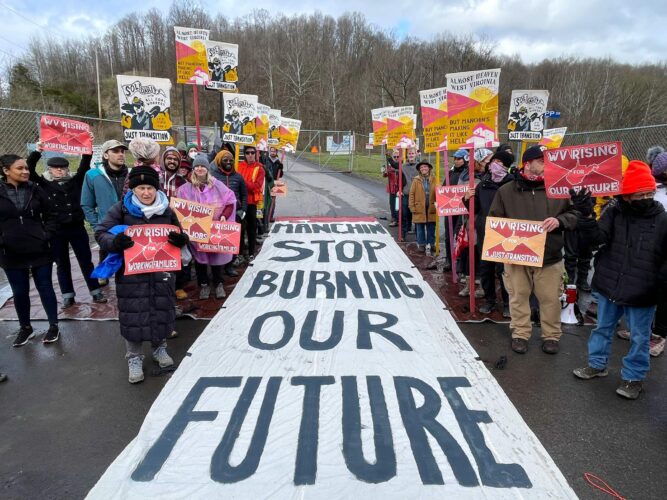
As climate justice movements turn towards the floundering talks in Denmark, people in Appalachia are in the fight of their lives to save Coal River Mountain and end mountaintop removal. On Dec. 7, we’ll be rallying and protesting at the WV Dept. of Environmental Protection (DEP) demanding that they stop the blasting on Coal River Mountain.

For almost a year Climate Ground Zero and Mountain Justice have joined coalfield residents in taking direct action to stop mountaintop removal operations in southern West Virginia (with over a 100 arrests) because agencies like the WV DEP refuse to do their jobs.

A few weeks ago, 13 activists in Washington D.C. staged a sit-in at the EPA headquarters demanding that they take action to stop the blasting on Coal River Mountain. On the same day in almost 30 cities, anti-mountaintop removal activists took action calling on the EPA and other entities to end mountaintop removal.

So please check your calendar and ask yourself: if you aren’t going to be Copenhagen, why won’t you be in West Virginia on Dec. 7.

CALL TO ACTION: Save Coal River Mountain Rally and Protest

West Virginia Dept. of Environmental Protection; Charleston WV; Dec 7 at 2pm

When:Monday, December 7, 2009; 2:00pm
Where: WV Dept. of Environmental Protection HQ– 601 57th Street SE, Charleston, WV
Contact:savecoalriver@gmail.com; www.savecoalrivermountain.org

Register Here on Facebook

In their insatiable quest to maximize profits Massey Energy has initiated mountaintop removal coal extraction operations on Coal River Mountain. The blasting has begun as the rumble of explosives and plumes of smoke coming from the mountain are being seen and heard. More »

Sumatra hunger strike: the last recourse for a forest community

Here in Riau, Indonesia, signs of the struggle to save the last of Sumatra’s forest is everywhere. Daily, the papers cover stories of timber and oil palm companies destroying forests, engaging in corruption, driving land conflicts, sponsoring violence, and marginalizing indigenous peoples.

Today, on the way to a meeting with the local NGO Elang, I passed villagers from the Kampar Peninsula, a carbon-rich and biodiverse ecoystem that is under attack by Sinar Mas’ oil palm operations and their timber division Asia Pulp and Paper (APP), on a hunger strike.

Hunger StrikeFlag reads: The Poor Indonesian Union_MG_7340

In front of the provincial parliament building, a group of men and women from the village of Kijang Kejo have set up a plastic tarp and banner, announcing to Riau’s elected officials that they will not eat until the oil palm plantation PT Arindo Tri Sejahtera, who stole their land and then paid thugs to kill three of their family members, is brought to justice.

More »

Tags: , , , , , , , , , , , , ,

RSPO Dispatch: Duta Palma destroys rainforests and lives

On the first day of the Roundtable on Sustainable Palm Oil (RSPO) Pak Jamaluddin was quiet. He said the air conditioning of Kuala Lumpor gave him the flu. He seemed lost among the groups of palm producers, with their Blackberries and dark suits.

Exhausted from the canoe rides, bad roads, the concrete maze of Jakarta, and the foreign environment of a Kuala Lumpor convention hall, I found Pak Jamaluddin on the second day of the RSPO outside, sitting cross legged on the sidewalk. He waved me over, and I sat with him. He leaned over to me as he whispered: “It is over. Our forest is gone. Duta Palma has flattened the last of it. We are finished.”

A few months before, I visited with Pak Jamaluddin in his village of Semunying Jaya. Deep in the interior of Borneo, his village had become a hotspot of rainforest destruction and human rights abuse at the hands of the palm oil producer Duta Palma.

More »

Tags: , , , , , , , , ,

Appalachia’s Spotted Owl: Will a Tiny Fly Stop Mountaintop Removal Mining?

Could it be that a tiny fly is the secret to saving Appalachia’s mountains and drinking water from the destructive mountaintop removal coal mining (MTR) practice?

According to Kevin Book, an analyst at ClearView Energy Partners LLC, in a Bloomberg piece this morning: “The future of mountaintop mining looks bleak.”

For the first time, the Environmental Protection Agency (EPA) in yet another step to do the right thing to protect the environment from MTR have told mining companies that they must safeguard the mayfly, one of the oldest winged insects.

“Applicants for new mines will have to show they wouldn’t cause pollution deadly to the aquatic bug. That puts at risk about $3 billion a year in coal that operators led by Massey and International Coal Group Inc. extract in Appalachia…
Without new permits, Massey Energy will rely more on conventional tunneling, CEO Don Blankenship said on an Oct. 28 conference call with analysts. The impact of permit restrictions may be felt beginning in 2011.

“We always worry about what EPA and others will do,” he said.

More than 1,200 miles (1,930 kilometers) of creeks and streams have been buried by mining debris in Appalachia from surface-mining techniques, including mountaintop removal, the EPA said in 2005.

Mining’s threat to mayflies, which hatch in streams and grow to a quarter-inch to more than an inch (2.5 centimeters) long, has been documented since the late 1990s. This year, the EPA under President Barack Obama for the first time held up new permits on the grounds of inadequate safeguards for the insect.”

While I had hoped that the contamination of precious drinking water, the demolition of historic mountains and the threat to community health from MTR would be enough cause to abolish the practice, at this point we are running against the dynamite fuse and every step counts. As RAN’s Dana Clarke put it: “The mayfly is a key indicator species and an entire order of them is disappearing, which from a biological/extinction point of view, is a very big deal in terms of what that says about the impacts on the ecosystem.” Let’s hope that in this case the mayfly is also an indicator that we will soon see MTR become extinct.