Understory: the Official Blog of RAN

Tar Sands Fighters to U.S. News Media: WAKE UP!

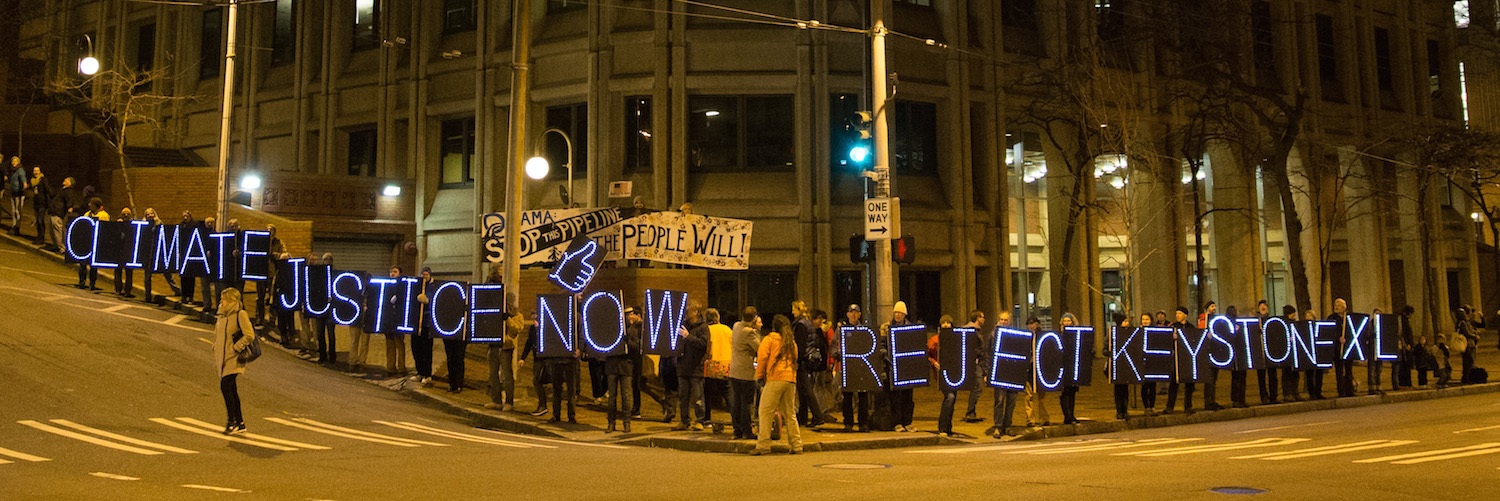
Over the past decade, as oil prices have risen ever higher, oil companies have begun a massive – and massively destructive – project of tearing Canada’s boreal forest to pieces, in order to get at a layer of sand that contains 10% oil. To get the oil out, they need three barrels of natural gas for every barrel of oil produced. The process creates vast lakes of polluted water – which already cover 50 square miles – that are seeping into the groundwater and rivers, poisoning Indigenous communities; already, thousands of ducks have died after landing in these wastewater lakes. The wreckage from this horribly destructive process already covers 500 square miles – but the area earmarked for future destruction is the size of Florida. Protests of Indigenous peoples are being ignored. Politicians are redirecting money from clean energy projects to finance tar sands research. And all this is happening in our friendly neighbor to the north, Canada – and U.S. oil companies are raking in huge profits from tar sands oil, and are pumping the world’s dirtiest oil from Alberta straight to your gas tank.

Sounds like a pretty important news story, right?

91brokaw

More »

Daryl Hannah: Why I Was Arrested in Coal River, West Virginia

(Posted by Branden for Daryl who joined RAN’s Michael Brune and others to protest MTR in West Virginia last week.)

Why would I fly across the country on my own dime knowing I would most likely end up in jail in one of the poorest parts of America?

Well, have you ever heard of MTR?

Don’t feel bad, my friends are intelligent well-read and informed people, but most of them had never heard of MTR (Mountain Top Removal) either.

So, I went to Coal River to help bring much needed attention to this hidden, criminal (but somehow legal) form of mining. I was honored to be joining an inspiringly brave group of concerned Americans, which included – NASA climate scientist James Hansen who was among the first to sound the alarm on the climate crisis. The sharp, charismatic, 94 year old, former West Virginia U.S. Representative and Secretary of State Ken Hechler, who was the first congressman to introduce a Federal bill to abolish strip mining in 1971. (If passed the bill could have prevented this mess we find ourselves in). And Michael Brune, executive director of Rainforests Action Network who is committed to ending to this terrible, destructive practice. I was deeply moved to be arrested with those affected by MTR in Kentucky, and the many local residents fighting for their very lives, including a half dozen senior citizens, canes, walkers and all.

Me with Dr. James Hansen at Marsh Fork Elementary School

Me with Dr. James Hansen at Marsh Fork Elementary School

Mountain Top Removal is a devastatingly destructive form of mining and has already destroyed 2,000,000 acres in the Appalachian Mountains.

Coal companies have literally blown up over 500 mountain tops to access the coal seams and then dumped the refuse into the valleys below, killing over 3000 miles of HEADWATER streams. The EPA just gave the go ahead for an additional 42 mountaintops to be blown off with another 6 permits pending.

Mountain Top Removal leaves behind a virtual hideous moonscape of devastated earth, billions of gallons of poisonous toxic sludge, and boarded up towns with dramatically high rates of cancer. More »

Congratulations Van Jones! Former RAN Board member is now White House Green Jobs Advisor

Author-activist tapped as White House ‘green’ jobs adviser – NYTimes.com.

Van Jones. What an amazing human being he is. One of the most passionate, articulate speakers I’ve ever had the pleasure to see and to meet. Not only does he have an impressive array of accomplishments to his name (Yale Law grad, co-founder of the Ella Baker Center for Human Rights, founder and executive director of Green for All) but he’s a truly remarkable man. A notoriously loving father of two, he grew up in Oakland and has risen above so much to become a truly inspired, and remarkably inspiring leader. And, he was on the RAN board of directors before he chose to narrow his focus – a focus that has led him to serve in this most hopeful of administrations in Washington. We now truly have a friend in the White House. Read on below to catch this New York Times story on his being chosen for this new and vital role, and check him out towards the end of this short RAN video.

Van – we’re all behind you.

——

The New York Times
March 10, 2009

Author-activist tapped as White House ‘green’ jobs adviser

Author and activist Van Jones will serve as a special White House adviser for “green” jobs, enterprise and innovation.

Jones, 40, will work within the Council on Environmental Quality, which coordinates President Obama’s climate, energy and other environmental policy initiatives with federal agencies.

“Van Jones has been a strong voice for green jobs, and we look forward to having him work with departments and agencies to advance the president’s agenda of creating 21st century jobs that improve energy efficiency and utilize renewable resources,” CEQ Chairwoman Nancy Sutley said in a written statement last night.

Jones, a Yale Law School graduate and veteran human rights and environmental activist, participated last month in the first meeting of the White House Task Force on Middle-Class Working Families. The panel, convened by Vice President Joe Biden, focused on how the public sector can create “green-collar” jobs such as installing solar panels and retrofitting inefficient buildings (E&ENews PM, Feb. 27).

Jones urged Biden and other administration officials who participated in the Philadelphia panel to use the $787 billion economic stimulus to provide training for such jobs, which cannot be outsourced. Economically depressed areas should be a priority, he underscored.

“Let’s green the ghetto first,” Jones said to applause.

Jones will now help shape the administration’s energy and climate initiatives, with special emphasis on improvements and economic opportunities in vulnerable communities, CEQ officials said.

Jones, who could not be reached for comment, is the author of the 2008 book “The Green Collar Economy: How One Solution Can Fix Our Two Biggest Problems” and the co-founder of the Oakland, Calif.-based Ella Baker Center for Human Rights. Most recently, he served as a senior fellow with the Center for American Progress, an influential think tank in Washington, D.C.

Joe Romm, a current Center for American Progress senior fellow and former assistant energy secretary during the Clinton administration, called Jones a “tireless” advocate for green-collar jobs in inner cities.

“He pushed this issue when no one was interested in it,” Romm added.

Jones’ candor and talent for firing up audiences will help in his new job, Romm posited.

“A big part of these bully pulpit jobs is selling ideas inside and outside of the administration,” he said. “Selling is one of his strong suits.”

Jones, who does not need Senate confirmation, will start his new job March 16, a CEQ spokeswoman said.

Copyright 2009 E&E Publishing. All Rights Reserved.

For more news on energy and the environment, visit www.greenwire.com.

The Spectre of Nationalization

It wasn’t that long ago (I think we can count it in months actually) that the terms ‘nationalize’ and ‘banks’ just wouldn’t ever have been found in the same sentence. Ever. Check out this whole article in the NY Times entitled: “Nationalization Gets a New, Serious Look”. One small excerpt:

“In an interview Sunday on “This Week” on ABC, the House speaker, Nancy Pelosi, alluded to internal debate when she was asked whether nationalization, or partial nationalization, of the largest banks was a good idea. “Well, whatever you want to call it,” said Ms. Pelosi, Democrat of California. “If we are strengthening them, then the American people should get some of the upside of that strengthening. Some people call that nationalization.”

Yes, some people do. Namely, most of the other people in the world when faced with the government owning the majority share in a company. What does this mean for the banks? Citi and Bank of America lead the pack as poster children for the declining financial sector. Ken Lewis has some serious egg on his face as the train-wreck that is Merrill Lynch pulls up to the station, and Citi is hiving itself off into smaller and smaller chunks to keep it’s head above water. Both are desperately in need of more government intervention to avoid collapse. Whatever we call it, let’s spend some serious time thinking about what kind of conditions should be placed on any public money for the private banks.

Obama F***ing Changed His Lightbulbs

I just saw this on Huffington post and I had to share. Newsweek got a great quote from Barack Obama on what goes through his head when he gets stupid questions about global warming during presidential debates:

I often find myself trapped by the questions and thinking to myself, ‘You know, this is a stupid question, but let me … answer it.’ So when Brian Williams is asking me about what’s a personal thing that you’ve done [that's green], and I say, you know, ‘Well, I planted a bunch of trees.’ And he says, ‘I’m talking about personal.’ What I’m thinking in my head is, ‘Well, the truth is, Brian, we can’t solve global warming because I f***ing changed light bulbs in my house. It’s because of something collective’.

No kidding.

Canada Wastes No Time in Pushing Dirty Oil on Obama

A report from the Globe and Mail today underscores just how important dirty oil is to Canada’s designs on the US energy markets:

Prime Minister Stephen Harper is proposing to strike a joint climate-change pact with president-elect Barack Obama, an initiative that would seek to protect Alberta’s oil sands projects from potentially tough new U.S. climate-change rules by offering a secure North American energy supply.

This will be *the* tell-tale on Obama’s ability to push new energy solutions past the considerable influence of the oil majors. Cheap oil is out. What’s left is much more energy intensive to produce. Industry distracts policymakers with the promise of Carbon Capture and Storage.  But even if CCS comes to pass (not bloody likely, but let’s say they make it in 2-3 decades from now, best case) and even if its implementation brings the carbon intensity of heavy crudes into line with conventional stuff, we’re only back to square one on the real problem–breaking free of a fossil-fueled economy. In fact, we’re two steps back because we’ve stranded our investments in an energy infrastructure that won’t outlast global warming.

One early sign of  how Obama will respond will be his selection for the top spot on Climate in the new Administration.  No doubt Canada’s oil lobby are rooting against reports that Mary Nichols is on the short list.  As head honcho at the California Air Resources Board, she’s overseen development of the Low Carbon Fuel Standard. Recently released drafts seek to reduce the carbon footprint of California’s transportation sector by imposing penalties on refineries that choose to process dirty crudes like those from Canada’s tar sands.  It’s a bold move, and target #1 for Canada’s oil lobby in the US.

5 Dirty Aspects of “Clean” Coal

Written by Sarah Lozanov

Published on October 9th, 2008 – Posted in alternative energy, carbon emissions

Clean coal has been getting a lot of attention lately. Both Mr. McCain and Mr. Obama consider it to be an important piece in their energy plans. Even the recent $900 billion bailout package included $1.5 billion for clean coal. Because coal is so plentiful and relatively cheap in the US, the notion of clean coal is particularly appealing. Unfortunately, clean coal is a myth. Here’s why clean coal is so dirty:

1. Clean Coal Requires More Coal

30% more energy is required to pump carbon underground for carbon capture and sequestration (CCS). The captured carbon dioxide has to be compressed to 100 times the atmospheric pressure, transferred to an underground storage reservoir and then pumped in the ground. All of this requires large amounts of energy, thus the coal plant must burn an additional 30% more coal to generate the same amount of usable electricity.

2. High Expenses Make It Unfeasiblesolar coal

$5.2 billion in taxpayer money has been spent to foster this technology in the US, yet the results are dismal. A recent government report found that of the 13 projects examined, eight had extended delays or financial problems, six were years behind schedule, and two had gone bankrupt.

3. Commercial Carbon Capture Unlikely by 2020

A study from Australian energy consultancy ACIL Talisman states that CCS will not be available in the short-term to generate electricity with low carbon emissions and that technology breakthroughs are still needed to make this technology feasible. The study does however find that concentrated solar, geothermal, and wind energy already are or will be in commercial use by 2020.

4. Unproven Technology

No commercial scale examples exist. The FutureGen plant in Illinois was to be the showcase for clean coal technology. A total of $50 million was spent, $40 million of which was federal funded. The price tag for the $1.8 billion plant had nearly doubled. The government pulled support for the project due to concern that costs would continue to climb.

5. Coal Mining is Very Harmful

The US averages 30 coal mining deaths annually, while China averages a staggering 8,000. Mountaintop removal mining, a method that is common in Appalachia, destroys ecosystems and has permanently buried over 1,200 miles of streams. Coal mining causes water pollution and lowers the quality of drinking water in neighboring communities. Unfortunately, clean coal technology does not address the many negative impacts of coal mining and could even require large amounts of coal to be mined because of the additional energy needed to sequester carbon emissions.