Understory: the Official Blog of RAN

Group Therapy For Banks Hooked on Tar Sands

After more than a year of denial, RBC may be admitting that it has a problem in the tar sands. Tomorrow, we’ve learned that RBC will host a group of more than a dozen international banks for what it calls a “day of learning”. The meeting comes just eight weeks after our letter to 68 banks signed on to the Equator Principles requesting that they forgo financing in the controversial industrial project.

RBC’s invitation-only meeting clearly aims to develop begin developing a coordinated response among banks to the growing controversy over tar sands financing. We got a peek at a draft agenda featuring Deputy Ministers from Alberta’s Environment and Energy Ministries, tar sands developers, selected environmental groups and at least one “First Nation representative”.

While we didn’t get an invitation to the meeting, volunteers are planning to make our presence known by distributing a special message to bankers in attendance.

We don’t know for sure which banks will show, but we’re expecting most of the 26 ranked in our earlier post on international banks backing the tar sands.

We’re happy to see RBC starting an important conversation in the banking industry, but actions speak louder than words. These banks should stop bankrolling dirty oil and shift those funds into clean energy.

Progress or PR? You decide! Tell us what you think in the comments.

  • Share/Bookmark

Why the U.S. is Strong on REDD but Weak on Climate

Here in Copenhagen (Day 5, 5:00 PM), delegates from all over the world are not surprised that the U.S. is playing a disappointing role in the climate negotiations, after all the science calls for 40% emissions reduction below 1990 levels by 2020, and the U.S. climate legislation calls for only 4%. This past summer, RAN opposed the Waxman Markey bill in the House of Representatives for many reasons, the largest being the inclusion of 2 billion tons in carbon offsets. These are 2 billion tons of carbon that U.S. polluters do not have to stop emitting, a gaping loophole in our effort to thwart climate change that keeps us addicted to fossil fuels.

Mountaintop Removal Coal Mining in West Virginia

Mountaintop Removal Coal Mining in West Virginia


Half of those offsets were to be used for domestic sources from sectors whose emissions are not capped, particularly the agriculture and forest sectors. The other half, 1 billion tons of offsets, are to come from international sources. The two major potential source of carbon offsets internationally would be:

1) The Clean Development Mechanism (CDM) or a similar regime of reduced emissions projects from developing countries. The CDM is quite controversial, and exists under the Kyoto Protocol, which the U.S. did not sign onto, so these CDM-like projects would theoretically need to emerge from the new agreement now being negotiated in Copenhagen.

2) And the second source would be carbon credits from international forests. This regime is also being negotiated right now in Copenhagen, and its outcome will influence if not determine the future for forest protection in the coming decade. A strong REDD deal with good safeguards would mean forest protection and the rights of forest dependent people respected. A weak REDD deal without strong safeguards would allow the continued logging of the intact natural rainforests in countries like Indonesia, Papua New Guinea, Brazil, and the Democratic Republic of Congo.

Bukit Tigapuluh, Sumatra. Credit: David Gilbert

Bukit Tigapuluh, Sumatra. Credit: David Gilbert


More »

  • Share/Bookmark

REDD Forest Agreement Still Missing Basic Elements for Sustainability

As negotiations wrapped up in Barcelona at the UN Climate Talks, the opportunity for a robust agreement to reduce emissions from deforestation and degradation in developing countries (REDD) is dangling from a wire. The latest negotiating text, which parties will be working on at the opening of the Copenhagen UNFCCC COP15, contains no provisions to monitor vital safeguards in developing countries which will receive funding to implement REDD, nor language that will ensure the protection of intact natural forests in those countries.

REDD is intended to help developing countries protect their remaining rainforests and reduce the 15-20 percent of global greenhouse gas emissions caused by deforestation, forest degradation and peatland destruction.
More »

  • Share/Bookmark

Big day for climate, Big new bill, and Big giveaways to coal, oil and loggers

With climate talks underway in Bangkok, Indigenous activists reviewing the text and engaged in the talks calling for no market-based REDD deal, Greenpeace activists blockading the tar sands in Alberta, and the EU investigating fraud in carbon trading schemes, today is a big day for the movement for climate justice.

Too bad it’s such a disappointing day for climate in the US. Today Senators Boxer and Kerry released their first draft of the Senate climate bill, a companion to the House ACES bill passed this past June. It calls for the US to reduce emissions by 20% of 2005 levels by 2020. By comparison, island nations and the world’s least developed countries are calling for 45% emissions reduction from 1990 levels by 2020.
More »

  • Share/Bookmark

Ground Zero is No Joke – impressions from Appalachia’s struggle against King Coal

Finding your way to Climate Ground Zero is easy if you know where you’re going.  Well, even then I’ve learned that Google will lead me astray from time to time. But in terms of what CGZ is, well, I thought I knew.

I didn’t have a clue.

Well, maybe that’s unfair.

I knew what was going on in the mountains of Appalachia, I knew that people were fighting a powerful company that is extracting coal and destroying mountains and communities, and I knew that Climate Ground Zero refers to where the main battle for our global climate is going on – here in the heart of Coal Country, in the US where we produce the lion’s share, per capita, of the world’s greenhouse gases and half of that comes from coal. I knew that this battle is seriously heating up. But I didn’t know how serious.

From Google Earth

From Google Earth

Of course it’s serious that a company is mining coal with machines bigger than office buildings and tremendous amounts of explosives, carried daily in tankers that rip along these narrow two lane highways.

And of course it’s serious when people’s families are endangered, their homes destroyed by floods caused by the mining, and the mountains that sustain so much life, so much diversity, are being wiped out for corporate profit. In this area that is stunningly beautiful, terrible things are indeed happening.

Since 1991 Massey Energy has led the pack in the race to take all the coal available from the once-hallowed mountains of Appalachia. They have systematically led the charge and taken the lion’s share of profit in the most efficient form of coal mining available, Mountaintop Removal.

The EPA continues to grant the permits that allow this company to employ far fewer workers than ever before in the history of coal mining. An underground mine used to employ as many as 500 workers. Now these operations can employ as few as 19. More »

  • Share/Bookmark

44 Arrested Protesting Cliffside Coal Plant

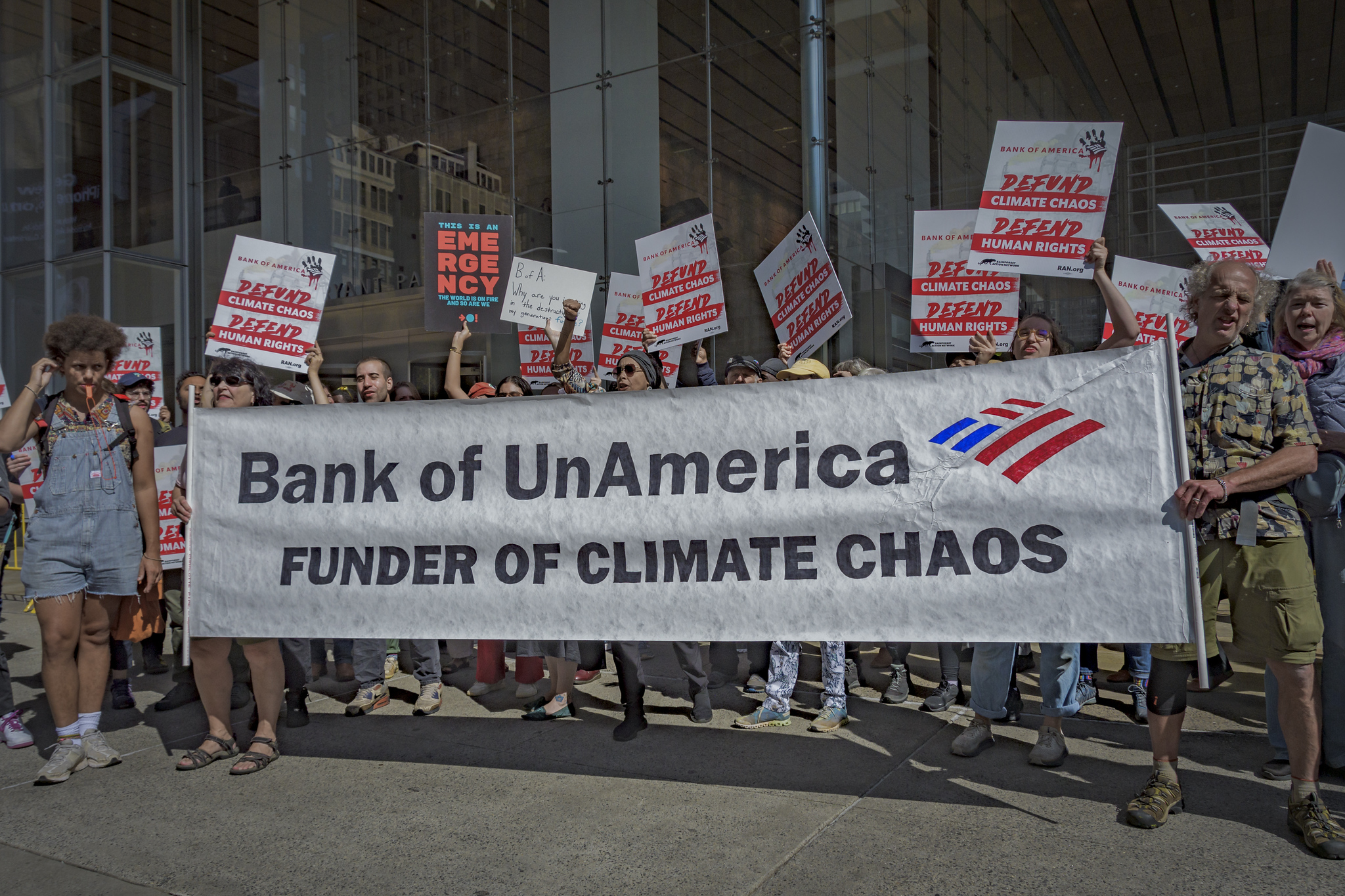
A few hours ago hundreds of protesters converged on the headquarters of Duke Energy in Charlotte NC to demand a stop to the construction of the Cliffside Coal-fired power plant. This is just the latest in the growing wave of civil disobedience that is building around the country demanding that we get America off coal – the number one cause of global warming pollution in the US. Duke Energy stands out as one of the most hypocritical utilities – on the one hand professing to care about the climate, and on the other, continuing to pursue the construction of two conventional coal-fired power plants. Citi and Bank of America both have outstanding financial relationships with Duke – and this protest, coming on the eve of Citi’s shareholder meeting and just a week before Bank of America’s, underscores the escalating reputational risk associated with their continued support of dirty coal.

Stay tuned for a report and photos from the ground from Scott Parkin.

  • Share/Bookmark

Why I might not invest in that coal plant after all

So there I was, thinking about this GREAT opportunity I just heard about to invest in a new coal-fired power plant.

But then, just yesterday, our own special envoy for climate change to the state department Todd Stern said in an interview with the Financial Times:

“How good will the business judgment of companies that make high-carbon choices now look in five, 10, 20 years, when it becomes clear that heavily polluting infrastructure has become deadly and must be phased out before the end of its useful life?”

He then followed this thought to its logical conclusion and pointed out that companies investing in things like coal-fired power plants and gas-guzzling cars – will start to see financial losses in the near future for their greenhouse gas emissions. I would argue with him on the “start” piece, but overall – nicely put.

But as if this weren’t already enough to make me think twice about that new coal-fired power plant investment…..today Dow Jones Newswire reported that in response to a new Trucost report that estimated the carbon footprint of 75 mutual funds’ portfolios, some mutual funds have stated that they will start to include carbon exposure in their evaluation of a company as a worthy investment.

So, what would I do if I was someone thinking of investing in a coal-fired power plant…..and I read these two things? Hmmmmm what would I do?

Are the CEOs of our major banks reading the news? Are they following current events? It looks bad for coal. Lets face it, it looks bad for all fossil fuels. So personally, I wouldn’t have financed several new coal-fired power plants in the last few months alone. Which is exactly what Citi, Bank of America and JP Morgan Chase have done — even since the release of the much heralded Carbon Principles. More to come on this, watch this space…..

  • Share/Bookmark

Beware Subprime Carbon

With the economy in meltdown, it’s no wonder that everyone is casting around for a fast way to make a buck. You can hardly turn around without hearing more dismal news about layoffs. Almost everyone (except maybe JPMC CEO Jamie Dimon who keeps telling everyone how much money he has) has been affected in some way, large or small by the unraveling of the financial system.

As everyone is casting around to try and sort out the mess left by investments in financial products that no one really understood and that turn out to have very little value, there is another quiet crisis brewing. Carbon Trading. Enviro’s and human rights groups like Carbon Trade Watch have been warning that carbon trading is unlikely to solve the climate crisis and is certainly going to lead to massive environmental justice abuses. But today, for the first time that I can think of, industry stepped up to say ‘whoa nelly this might just be another case of subprime investing’.

Vincent de Rivaz, the chief executive of the UK arm of the French-owned gas and electricity group, being quoted in the UK Guardian said: “We like certainty about a carbon price,” he said. “[But] the carbon price has to become simple and not become a new type of sub-prime tool which will be diverted from what is its initial purpose: to encourage real investment in real low-carbon technology.”

The article goes on to point out that the recent economic downturn has sent steelmakers and hedgefunds rushing to cash-in the carbon credits that they received for FREE under the European Trading Scheme – sending the price of carbon plummeting down. Which more or less defeats the purpose of having a price on carbon in the first place. The problems with relying exclusively on market mechanisms to deal with climate change are legion, but perhaps the least talked about is the fact that at their root, carbon credits are…essentially manufactured financial products, much like the raft of such products that got us into the current financial mess we’re in. That is not to say that there is no place at all for carbon trading in the complement of policies and approaches needed to tackle climate change, but it is a word of warning. And when that warning starts to come from none other than the very industries that have been carbon tradings most ardent supporters, it’s time to listen.

  • Share/Bookmark

A stimulating stimulus?

The new administration is up to its eyeballs trying to pull off an economic stimulus package that will genuinely stimulate the economy while also (to their credit) meeting another critical need – to jumpstart the transition to a green energy system. I don’t envy them that job, not for one second – particularly because at the same time, officials charged with overseeing the bank bailouts (otherwise known as the Troubled Assets Relief Program) are struggling to figure out how to hold the banks accountable for spending that money in a way that has broad benefits. It would be a crying shame if all the bailout money used by the banks went to finance the old carbon intensive fossil fuel infrastructure, thereby undermining the laudable intentions enshrined in the economic stimulus package. A fact that is apparently not lost on HSBC for one (bank). Bill Becker, writing on Climate Progress says:

On January 19, HSBC Global Research issued an analysis of the economic stimulus packages passed or pending in 15 nations, including the United States. It found that these countries plan to invest more than $3 trillion to stimulate their economies over the next decade. Only about 14% of that amount will be invested in green technologies – defined by HSBC as low carbon power, energy efficiency, water treatment and pollution control.

The amount of green investment ranges from 0% in Poland (a country stubbornly dependent on coal) to 69% in South Korea. China plans to dedicate 34% of its stimulus package to green initiatives; the stimulus package approved by the European Union invests 14%. Overall, HSBC calculates, about $432 billion is earmarked for green investments among the 15 nations it studied, with about 50% of that amount expected to be invested in 2009.

The United States? By HSBC’s calculation, 16% of the proposed $825 billion stimulus package targets green investments. One of the key questions Congress must ask, and answer quickly, is whether that’s sufficient stimulus for a new energy economy and sufficient evidence of U.S. leadership. Put another way: How much of our children’s money will we spend on life-support for the old carbon economy and how much will we invest to build the new one?

Stimulating a green economy will require more than a disbursement of the one-off stimulus package – it will require a long-term redirecting of public and private capital into renewables and energy efficiency.

  • Share/Bookmark

The Spectre of Nationalization

It wasn’t that long ago (I think we can count it in months actually) that the terms ‘nationalize’ and ‘banks’ just wouldn’t ever have been found in the same sentence. Ever. Check out this whole article in the NY Times entitled: “Nationalization Gets a New, Serious Look”. One small excerpt:

“In an interview Sunday on “This Week” on ABC, the House speaker, Nancy Pelosi, alluded to internal debate when she was asked whether nationalization, or partial nationalization, of the largest banks was a good idea. “Well, whatever you want to call it,” said Ms. Pelosi, Democrat of California. “If we are strengthening them, then the American people should get some of the upside of that strengthening. Some people call that nationalization.”

Yes, some people do. Namely, most of the other people in the world when faced with the government owning the majority share in a company. What does this mean for the banks? Citi and Bank of America lead the pack as poster children for the declining financial sector. Ken Lewis has some serious egg on his face as the train-wreck that is Merrill Lynch pulls up to the station, and Citi is hiving itself off into smaller and smaller chunks to keep it’s head above water. Both are desperately in need of more government intervention to avoid collapse. Whatever we call it, let’s spend some serious time thinking about what kind of conditions should be placed on any public money for the private banks.

  • Share/Bookmark